Skip to content
7.8 Management of Bleeding
7.8 Management of Bleeding
Bleeding Overview
Types of Bleeding
Types of Vessels
Types of Wounds
Management of Bleeding ( No Foreign Body)
Management of Bleeding (Foreign Body)
Uncontrolled Life Threatening Bleeding (Tourniquet)
Management of Bleeding Amputation
Bleeding is defined as loss of blood. The loss can range from minor bleeding through to severe external and internal bleeding
Types of bleeding
Internal
Bleeding caused by damage to vessels or organs that remains in the body
External
Bleeding that is visible due to loss from a wound
Types of vessels
Arteries
Vessels that lead away from the heart (in almost all circumstances carry oxygenated blood)
Veins
Vessels that lead to the heart that mainly carry waste gases after a large amount of the oxygen has been absorbed by tissue
Capillaries
Small vessels which have thin walls that can facilitate exchange of particles (gas)
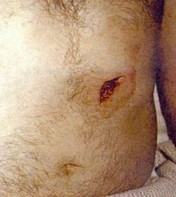
Penetrating wounds
Stabbing
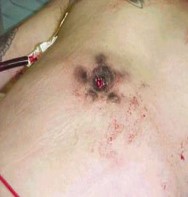
Gun shot (ballistic)
Debris from explosions
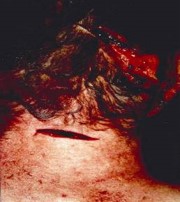
Incisions
Knife slicing
Abrasion
Caused by friction of skin being rubbed against rough surface (similar characteristics to some burns)
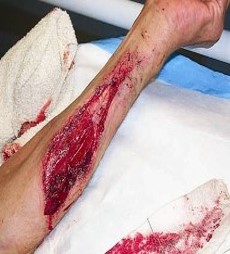
Laceration
Tearing type of wound that may occur by being caught in machinery or barbed wire
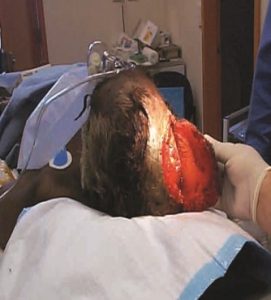
Evulsion
Skin is pulled away from the underlying surface, can also be known as an de-gloving injury
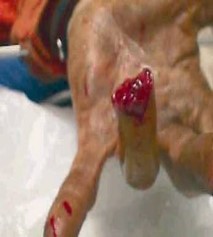
Amputation
Part of a limb is physically separated from the body
Stab Wound
Gunshot Wound
Incision
Abrasion
Laceration
Evulsion
Amputation
Management of bleeding (no foreign body)
Sit or lay patient down
Inspect for foreign bodies
Apply direct pressure bandages
Check circulation via pulse or capillary refill
Refer to medical advice (re stitching etc.)
If bleeding continues apply further compression bandaging
Inspect
Support
Pad
Bandage
Management of bleeding (foreign body)
Apply pressure around the edges of the foreign body
Apply a pressure pad using ring pad or pads each side of the foreign body
Apply compression bandage the around outside of foreign object
Inspect
Pad
Uncontrolled life threatening bleeding – Tourniquet
Unable to be controlled with direct pressure
5cm wide bandage, 5-7cm above bleeding point
Tight enough to stop all circulation to limb
Time of application noted and passed to paramedics
Should not:
Be over a joint or wound
Covered up by bandages or clothing
Consider Haemostatic Dressing if available
Management of bleeding (Amputation)
Partial Amputation
Control bleeding
Immobilise fractures as required
Cover with sterile dressing
Full Amputation
Control bleeding
Cover with sterile dressing
Place body part in airtight sealed plastic bag
Place bag containing body part in ice water (do not allow body part to contact ice water)
Ensure part goes to hospital with patient
Login
Accessing this course requires a login. Please enter your credentials below!
Username or Email Address
Password
Remember Me
Lost Your Password?