7.10 Burns

A burn injury results from a combination of a thermal or other tissue damaging source, the temperature and the time of exposure to the body. The sources of burns include:
Heat Explosions, flame, steam or liquids.
Chemicals – Alkalis and acids.
Electricity – Faulty or damaged cable.
– Sunburn or radioactive sources.
– Rope or skidding on a surface causing heat. – Contact with dry ice and extreme cold.

Causes of Burns

  • Heat: Explosions, flame, steam, liquids
  • Chemicals: Acids and Alkalis
  • Electricity: Damaged tissue due to flow of
electricity through skin and organs
  • Radiation: Sun burn
  • Friction: Rope burns (also abrasions may
be considered a type of friction burn)
  • Cold: Dry ice, frostbite

Severity of burns are determined by

  • Temperature
  • Exposure to source
  • Area and depth
Classification of burns
Partial thickness / Superficial
  • Burns to only the outer layer of tissue
Full thickness
  • Burns that progress through the full layers of skin and may include underlying tissue or organs

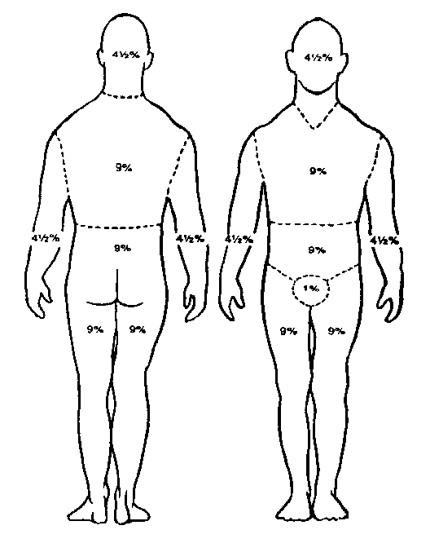
Rule of Nines

  • Head – 9%
  • Chest / upper back – 9% each
  • Abdomen / lower back – 9% each
  • Genital area – 1%
  • Front of the leg /Back of the leg – 9% each
  • Arm – 9% each
Significant burns defined as:
  • Burns >10% total body surface area (TBSA)
  • Full thickness burns >5% TBSA
  • Burns of special areas
  • Face, Hands, Feet
  • Genitalia, perineum
  • Major joints
  • Electrical Burns
  • Chemical Burns
  • Burns with associated inhalation injury
  • Circumferential burns
  • Burns in the very old or very young
  • People with complicating conditions
  • Burns with trauma
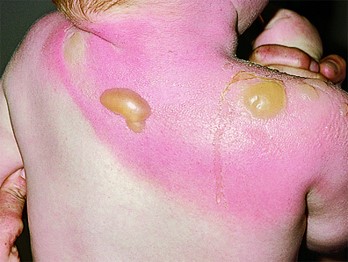
Superficial & Partial Thickness
  • Redness
  • Blanching
  • Blistered
  • Painful
  • Exudes Plasma
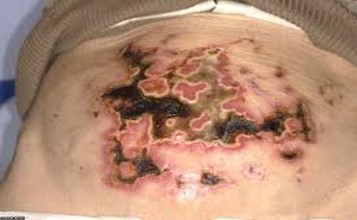
Full Thickness
  • Pain only around edge
  • Often Dry & Leathery
  • Blanches white on pressure
  • May be brown, black or marble-like
Thermal Burns:
  1. Do not remove clothing that is stuck to the
  2. Remove jewellery if possible. Burns cause swelling, if a ring is left on the casualty it can act as a tourniquet and restrict blood
Sunburn:
  1. Cool the sunburn with cool, running
  2. Stay out of the
  3. Give cool
Medical aid for infants and casualties with blisters
Chemical Burns
  • Do not self contaminate
  • Use copious quantities of water to dilute the chemical and to wash it from casualty’s skin
  • Remove contaminated clothing
  • Do not apply neutralizing agent
  • If swallowed, milk and call the “poison line” 13 11 26
Electrical Burns:
  1. Follow DRSABCD Action Plan – Complete a risk/hazard assessment.
  2. Check for danger and ensure the power is turned off wherever possible.
  3. Remove casualty from electrical supply. Do not directly touch the casualty, use dry non-conductive materials such as a broom handle.
  4. Urgent medical aid.
All burns
  • Keep the casualty comfortable
  • Do not apply creams, oils ointments, remove clothes stuck to skin, let them get cold
  • Call for an ambulance Reassure the casualty